
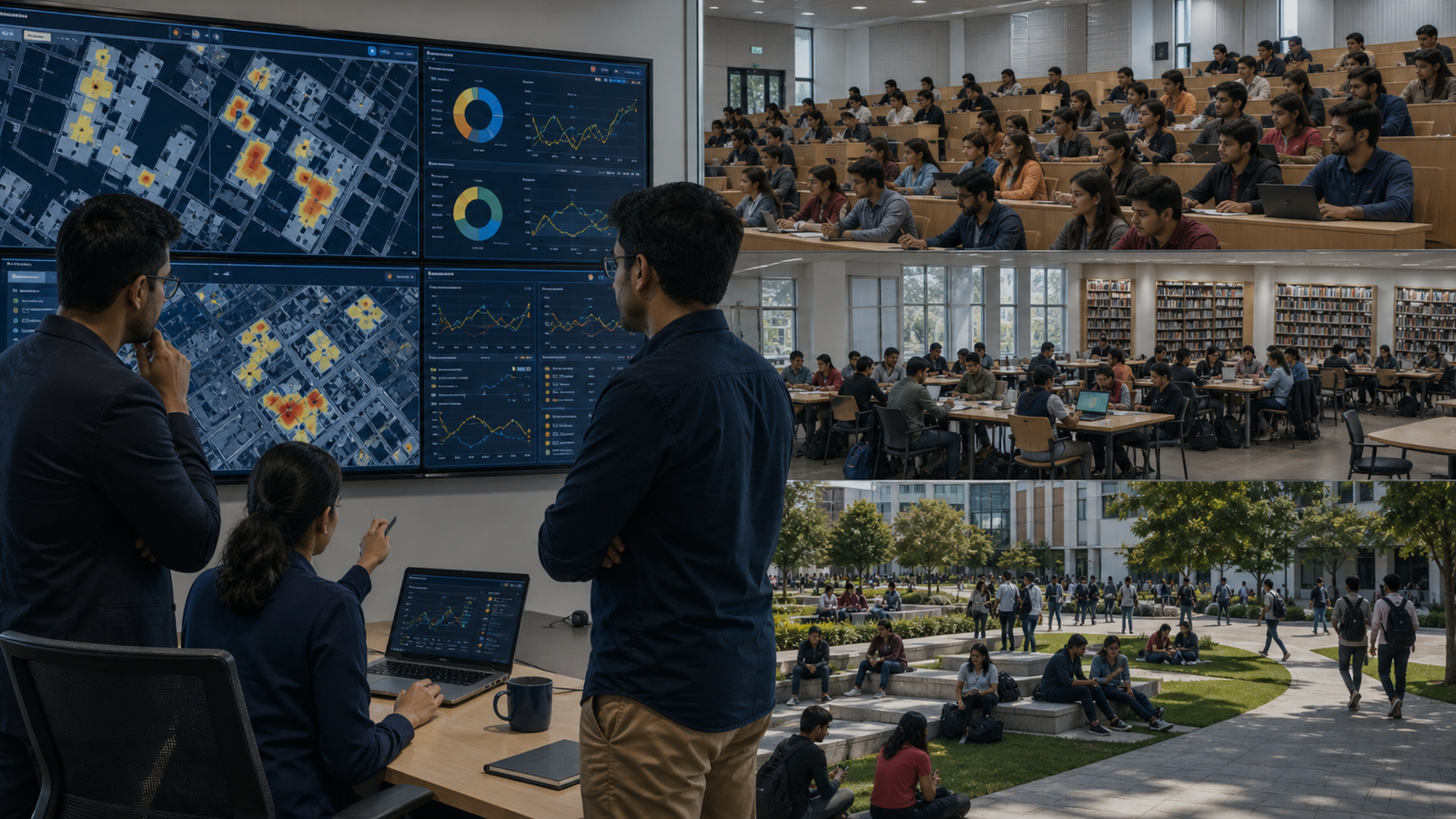
More access points do not automatically create a better campus experience
When students or faculty report weak Wi-Fi, the visible response is often to add or replace hardware. That may be necessary, but it is not a diagnosis. Wireless performance is the result of an entire service environment: radio design, wired switching, internet capacity, authentication, device behaviour, applications, building materials, operating practices and the pattern in which people use campus spaces.
A university can therefore spend more and still experience congestion, unstable roaming, slow authentication or inconsistent coverage. The issue is not that hardware lacks value. The issue is that hardware is being asked to compensate for requirements or constraints that have not been properly understood.
Coverage is not the same as usable capacity
A heat map may show that a space has signal, yet users may still have a poor experience. Lecture halls, examination centres, libraries, hostels and auditoriums can place very different simultaneous demands on the network. A design based primarily on floor area or nominal user count can miss device concurrency, traffic direction, application sensitivity and short periods of extreme demand.
Leadership should ask whether the upgrade is designed for the way each space is used. A quiet administrative corridor and a full lecture theatre cannot be treated as equivalent coverage zones.
The wired foundation may be the limiting factor
Wireless access points depend on switching capacity, uplinks, power, cabling, internet connectivity, addressing, core services and resilient design. Newer radios connected to constrained backhaul do not remove the bottleneck; they can make it more visible. Likewise, insufficient power budgets, ageing cabling or inconsistent switch configurations can prevent new equipment from operating as intended.
A campus Wi-Fi decision should therefore include the end-to-end path, not only the wireless layer. The requirement is a reliable user service, not a count of installed devices.
Radio conditions are local and dynamic
Campus buildings contain concrete, glass, metal, equipment, furniture and changing occupancy. Interference may come from neighbouring networks, personal hotspots, specialised devices or poor channel planning. An installation based on drawings alone may not reflect the live environment.
Site surveys, spectrum observations and post-installation validation matter, but they should be designed around representative operating conditions. A survey conducted in an empty building may not reveal what happens when hundreds of users arrive with multiple devices.
Authentication and policy can feel like a Wi-Fi failure
Users experience the service as one journey. If onboarding is confusing, certificates fail, identity services are slow, guest access is cumbersome or policy changes are inconsistent, users will describe the problem as bad Wi-Fi even when radio connectivity exists.
The review should map the full user experience from discovery and authentication through application access and movement between spaces. Network, identity, security and support teams need aligned ownership of that journey.
Device and application behaviour has changed
Students and faculty may carry several devices, use video-rich collaboration, access cloud platforms, synchronise large files and move continuously between buildings. Research and specialist applications may have different latency, throughput or security needs. Historical utilisation can inform planning, but it should not be treated as a complete forecast of future demand.
At the same time, not every application requires the highest possible performance everywhere. Service classes and priorities should reflect academic and operational importance rather than applying one undifferentiated target across the campus.
Operations determine whether design quality is sustained
Even a well-designed network can deteriorate through unmanaged configuration changes, firmware inconsistency, incomplete monitoring, poor incident categorisation or lack of ownership. If support teams cannot distinguish radio, authentication, backhaul, internet and application problems, recurring issues remain hidden behind general complaints.
The investment case should include operating visibility, baseline measures, skills, escalation paths, documentation and periodic optimisation. Wi-Fi is an ongoing service, not a one-time installation.
A better sequence for the next upgrade
Start by defining the user and institutional outcomes. Segment the campus by use, density and criticality. Establish current evidence across wireless, wired, identity, internet and application layers. Identify what can be retained or reconfigured. Translate the findings into measurable requirements, then invite solution options against the same criteria.
During delivery, validate representative high-density and mobility scenarios. Confirm monitoring, handover and ownership before acceptance. Measure the outcome after occupancy returns to normal patterns.
The central lesson is straightforward: higher spending improves performance only when it addresses the real constraint. A business-first, evidence-led assessment helps the university invest in the connected environment that teaching, research and campus operations require—not simply in a larger hardware count.
ShivPriya perspective Business First. Technology Second. Vendor Neutral.